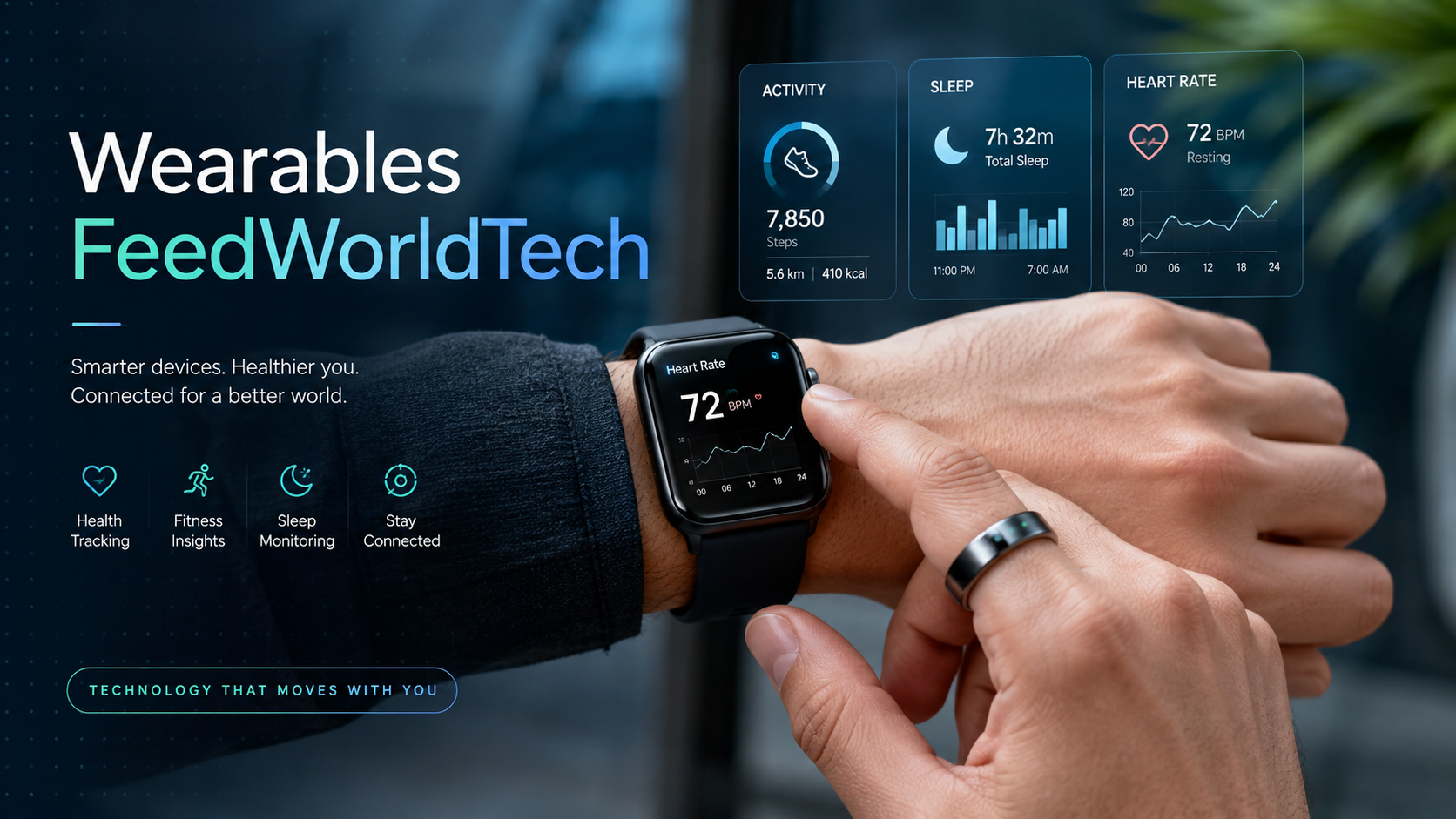
If you searched for wearables feedworldtech, you may be trying to work out whether the phrase describes a particular product, technology platform, or category of wearable devices. That distinction matters because the available evidence points to a simpler explanation.
Feed World Tech has published content discussing smart wearables and uses the phrase “wearables feedworldtech,” including in an article dated August 1, 2025. However, the phrase does not appear to identify a recognized technical standard, standalone wearable platform, or specific device. FeedWorldTech-related pages instead use it in the context of general technology coverage.
For readers, the useful question is therefore broader: what are modern wearables, how do they work, what can they realistically tell you, and what should you check before trusting or buying one?
What Does “Wearables FeedWorldTech” Actually Mean?
Based on currently accessible sources, wearables FeedWorldTech is best understood as a search phrase connected with FeedWorldTech’s coverage of wearable technology rather than an established industry term.
A Feed World Tech article titled Smart Wearables 2025: What to Expect? A FeedWorldTech Perspective discusses smartwatches, smart clothing, wearable trends, and technology development. The site’s broader content also covers gadgets, software, technology news, and other technology-related subjects.
There is also a FeedWorldTech.org website whose terms explicitly refer to information about “wearables FeedWorldTech.” That site describes its material as informational content based on research and public sources. Because multiple similarly named domains appear in search results, readers should avoid assuming that every FeedWorldTech-branded page belongs to the same publisher or organization unless ownership is independently confirmed.
Most importantly, there is no strong evidence from established technical or regulatory sources that “Wearables FeedWorldTech” is the formal name of a smartwatch, operating system, health platform, sensor technology, or wearable-device ecosystem.
What Counts as Wearable Technology?
Wearable technology refers broadly to electronic devices designed to be worn on or close to the body while performing computing, sensing, communication, or monitoring functions.
The category is much wider than smartwatches. Wearables can include fitness bands, rings, sensor patches, specialized medical monitors, smart clothing, head-mounted devices, and other body-worn electronics. In its digital-health materials, the U.S. Food and Drug Administration specifically identifies wearable forms such as smartwatches, rings, patches, and bands among sensor-based digital health technologies.
What makes a device genuinely “smart” is usually the combination of hardware and software. A basic watch displays information. A smartwatch can also collect sensor readings, process data, communicate with another device, and turn those readings into information a person can use.
That distinction explains why wearables have become relevant well beyond simple step counting.
How Modern Wearables Work
Although designs vary, most consumer wearables follow a similar process.
First, one or more sensors collect information. An accelerometer may detect movement, while an optical sensor can estimate pulse-related signals. Depending on the device, additional hardware may measure location, temperature, electrical signals, orientation, or other variables.
Next, software processes those raw signals. A stream of movement data by itself isn’t especially useful to most people. Algorithms can interpret patterns in that data and convert them into recognizable metrics such as steps, activity periods, estimated sleep, or workout information.
Many devices then synchronize information with a companion phone application or cloud service. The app gives users a more detailed view of trends than a small wearable screen can provide.
This process is why two devices containing similar sensors can sometimes produce different results. Hardware matters, but algorithms, placement on the body, sampling methods, software updates, and the way a manufacturer defines a metric can also affect the final number.
What Can Wearable Devices Be Used For?
Fitness and everyday activity
Activity tracking remains one of the most familiar applications. A wearable can make everyday movement more visible by recording metrics such as steps, workout duration, pace, or heart rate.
The real value often comes from trends rather than a single reading. Someone who walks regularly, for example, can use historical data to see whether their activity has increased or decreased over several weeks.
Wearables can also reduce the need to manually record every workout. That convenience matters for people who mainly want a consistent record rather than highly specialized sports analysis.
Sleep and recovery tracking
Many consumer wearables attempt to estimate when a person sleeps, how long they sleep, and sometimes how their sleep is divided into different stages.
These results require careful interpretation. Sleep wearables generally infer sleep from indirect signals such as movement and cardiovascular measurements rather than measuring brain activity in the same way as a clinical sleep study. Research continues to show that performance varies across devices and sleep metrics.
For a general user, that means a wearable may be more useful for noticing consistent changes in sleep habits than for treating every reported sleep stage as a medical-grade measurement.
Health-related monitoring
Some wearables collect health-related measurements, but there is an important distinction between general wellness features and regulated medical functions.
The FDA’s digital-health framework covers technologies ranging from general wellness products to medical devices, and it maintains information about authorized sensor-based digital health devices. In January 2026, the agency also updated its guidance addressing low-risk products intended to promote a healthy lifestyle.
A consumer wearable should therefore not automatically be treated as a medical device simply because it displays health information.
If a measurement could influence diagnosis, medication, or treatment, users should check the product’s actual regulatory status and discuss concerning results with an appropriate healthcare professional rather than relying on marketing language alone.
Notifications and everyday convenience
Many wearables also function as extensions of other digital devices. Depending on their design, they may provide alerts, timers, navigation information, contactless functions, music controls, or access to selected phone features.
For some users, these features become more useful than health tracking. Being able to see a notification without repeatedly taking out a phone is a small benefit, but one that occurs many times during a normal day.
Work and specialized environments
Wearable technology also has applications outside the consumer market. Research has examined devices used for occupational safety, ergonomics, environmental monitoring, fatigue management, asset tracking, and connected-worker systems.
These industrial and professional wearables often have very different requirements from a fitness watch. Reliability, protective equipment compatibility, security, battery life, and integration with workplace systems may matter more than appearance or lifestyle features.
How Accurate Are Wearables?
Accuracy is one of the most misunderstood parts of wearable technology.
A device displaying a precise-looking number does not mean that the underlying measurement is perfectly precise. Different metrics can have very different levels of reliability.
A systematic review of commercially available wearables found that step and heart-rate measurements can perform reasonably well in laboratory conditions, while accuracy varies by manufacturer and measurement type. Estimating energy expenditure, such as calories burned, has generally been more challenging.
Other research has also found that wearable performance can change with activity type, device design, testing conditions, and the physiological measure being assessed.
This doesn’t make wearable data useless. It changes how it should be interpreted.
For everyday fitness, trends can often matter more than tiny differences between individual readings. If your device shows a consistent decline or improvement over time under similar conditions, that pattern may be more informative than debating whether one day’s figure was perfectly accurate.
For medical decisions, the standard should be much higher.
Benefits of Wearable Technology
A well-chosen wearable can make personal data easier to collect and understand.
Because the device is worn rather than manually operated for every measurement, it can capture information more consistently than a person might record in a notebook or phone app. Researchers are interested in wearables partly because continuous or repeated real-world measurements can reveal patterns that brief observations may miss.
Wearables can also provide fast feedback. Instead of waiting until the end of the week to consider how active you’ve been, you can see a developing pattern during the day.
Another benefit is convenience. A device on your wrist, finger, clothing, or body can perform a narrow task without requiring constant attention.
The biggest advantage, however, depends on the user. A runner may value workout data. Someone else may care about sleep consistency. Another person may simply want notifications without checking a phone.
A longer feature list doesn’t automatically mean a better wearable.
Limitations That Matter in Everyday Use
Wearables also introduce trade-offs that are easy to overlook when comparing specifications.
Battery charging can interrupt tracking. A device that lasts only until the moment you normally sleep may be unsuitable if sleep monitoring is your main reason for buying it.
Comfort matters just as much. Even an advanced device becomes ineffective if you dislike wearing it.
Data can also become fragmented. Research has identified interoperability—the ability of different devices and health systems to exchange and use data consistently—as a continuing challenge in wearable technology.
Then there is interpretation. Collecting more measurements doesn’t automatically produce better decisions. People can end up focusing on daily fluctuations that have little practical meaning.
The most useful wearable is usually the one that measures something you genuinely care about, does it well enough for your purpose, and fits naturally into your routine.
Privacy and Security: What Happens to Wearable Data?
A wearable may collect information about movement, sleep, exercise, location, or health-related behavior. That makes privacy an important purchasing consideration rather than an optional technical detail.
Users should find out where their data is stored, which information is uploaded to the cloud, what permissions the companion app requests, whether data can be deleted, and whether information is shared with third parties.
Health data also doesn’t automatically receive identical legal protection everywhere.
In the United States, for example, the Federal Trade Commission has emphasized that some health apps and connected devices fall outside traditional HIPAA-covered healthcare relationships. The FTC’s Health Breach Notification Rule can apply to certain health apps and similar technologies that handle identifiable health information.
Security deserves similar attention. NIST research on mobile and wearable devices has examined risks involving device pairing, authentication, encryption, software vulnerabilities, and communication between wearables and other devices.
Consumers don’t need to become cybersecurity experts. They should, however, use strong account security, install legitimate updates, review app permissions, and consider a manufacturer’s software-support record before trusting a device with sensitive information.
Compatibility and Cost Considerations
The purchase price is only one part of a wearable’s cost.
Some devices depend heavily on a particular smartphone operating system or companion application. Others provide limited functionality without an internet connection, cloud account, or phone nearby. Feature availability may also differ by country because of software, regulatory, language, or service limitations.
Before buying, check compatibility with your current phone and confirm that the specific feature you want is available on both your device and in your region.
Also investigate ongoing costs. Certain wearable ecosystems may offer optional or required subscriptions for advanced services, while replacement straps, chargers, accessories, cellular plans, or battery servicing can add to long-term ownership costs.
Because prices and subscription terms change frequently, they should always be verified directly with the manufacturer or authorized retailer rather than relying on an old comparison article.
How to Choose a Wearable Without Paying for Features You Won’t Use
A practical buying process is more useful than starting with the device that has the longest specification sheet.
- Choose your main purpose. Decide whether you primarily want activity tracking, sports metrics, sleep information, health-related features, notifications, navigation, or another function.
- Check compatibility first. Confirm that the wearable works properly with your phone, operating system, required applications, and country.
- Research the exact measurement you care about. Don’t assume that strong heart-rate performance means equally strong sleep, calorie, or location accuracy.
- Separate wellness from medical claims. If you need a feature for a health condition, check whether the exact device and function have appropriate regulatory authorization in your jurisdiction.
- Review battery life and comfort. A technically impressive device isn’t useful when it spends too much time off your body.
- Read the privacy policy and support information. Look for clear explanations of data collection, account controls, deletion options, software updates, and security practices.
- Calculate ongoing costs. Include subscriptions and accessories rather than comparing only initial prices.
- Ignore features you won’t actually use. Paying extra for dozens of measurements adds little value if you only need dependable workout tracking.
Who Is Wearable Technology Best Suited To?
Wearables make the most sense for people who have a specific reason to collect regular data.
That could include someone trying to build a consistent activity routine, a recreational athlete who wants workout trends, a person interested in tracking sleep habits, or a user who values wrist-based notifications and basic phone controls.
A wearable may be less useful if you dislike wearing accessories, don’t want another device to charge, rarely look at historical data, or aren’t comfortable placing additional personal information in an app-connected ecosystem.
There’s nothing inherently better about tracking more aspects of daily life. A wearable earns its place when the information changes something useful for you.
Where Wearable Technology Is Heading
The direction of wearable development is broader than simply adding more smartwatch features.
Regulators and researchers are already working with multiple body-worn forms, including watches, rings, bands, and patches, while academic work continues on wearable sensors, connected health technologies, power consumption, communications, and new methods of collecting physiological information.
The harder challenge is increasingly not whether a sensor can collect data, but whether that data is accurate, secure, understandable, interoperable, and useful enough to justify collecting it.
That distinction will matter as wearables move closer to healthcare, workplace monitoring, and other situations where incorrect conclusions carry greater consequences.
FAQs
1. What is wearables FeedWorldTech?
Wearables FeedWorldTech appears to be a search phrase associated with FeedWorldTech content about wearable technology. Feed World Tech published an article about smart wearables in August 2025 that uses the phrase, but available authoritative sources do not establish “Wearables FeedWorldTech” as a specific device, platform, or recognized technical category.
2. Is FeedWorldTech a wearable technology company?
The publicly accessible pages reviewed for this article present Feed World Tech primarily as a website publishing technology-related content, including articles about gadgets, software, technology news, and smart wearables. The sources reviewed do not establish it as a manufacturer of wearable hardware.
3. What are the most common types of wearable devices?
Common forms include smartwatches, activity trackers, smart rings, sensor bands, patches, head-worn devices, and specialized wearables used for medical or professional purposes. The FDA’s sensor-based digital-health resources specifically include wearable forms such as smartwatches, rings, patches, and bands.
4. Are smartwatch health readings medically accurate?
Not automatically. Accuracy depends on the device, sensor, metric, activity, algorithm, and testing conditions. Research suggests that some consumer devices can measure metrics such as heart rate reasonably well in certain circumstances, while measurements such as energy expenditure can be less reliable. Medical decisions should rely on appropriately validated or authorized tools and professional guidance.
5. Can a fitness tracker replace a medical device?
A normal fitness tracker should not be assumed to replace a medical device. Consumer wellness products and regulated medical technologies can look similar while having very different intended uses and regulatory requirements. Check the regulatory status of the exact device and feature if you need it for diagnosis, monitoring, or treatment decisions.
6. Is wearable health data private?
Privacy protections depend on the service, jurisdiction, type of data, and organization handling it. Consumer health information is not necessarily governed by the same rules as records held by hospitals or healthcare providers. Users should review privacy policies, permissions, data-sharing practices, deletion controls, and account-security settings before using a health-focused wearable.
7. What should I check before buying a wearable?
Start with your main use case, then verify phone compatibility, regional feature availability, battery life, comfort, measurement quality, privacy practices, software support, and any recurring subscription costs. If you need a health-related function, confirm the exact feature’s regulatory status rather than assuming that every measurement on the device is medically validated.
Conclusion
The phrase wearables feedworldtech is easier to understand once it is separated from the wider wearable-technology market. Current evidence shows that FeedWorldTech-related websites discuss wearable technology, but there is not enough reliable evidence to describe “Wearables FeedWorldTech” as a distinct device, platform, technical standard, or established product ecosystem.
Wearables themselves can be genuinely useful. They can make activity, workouts, sleep patterns, notifications, and certain health-related measurements easier to monitor. Their usefulness still depends on accuracy, comfort, compatibility, privacy, battery life, and whether the collected information helps you make better decisions.
The sensible approach is to choose a wearable for a clearly defined purpose, understand the limits of its measurements, and verify medical or security claims rather than trusting a feature name alone.
Read also Digital Infusing Aggr8Tech: Meaning, Uses and What’s Verified